During a bushfire, 95% of homes lost are due to Ember Attack!

Rainmaker Bushfire Sprinklers
  • Home
  • Shop
  • Why Trust Us
    • Our Mission
    • Our Team
    • Contacts
    • Terms & Conditions
  • How it Works
    • The Basics
    • Design & Plan
    • BAL-LOW
    • BAL-12.5 to 19
    • BAL-29 to FZ
  • Products
    • Portable Sprinklers
    • Fixed Heads & Nozzles
    • Our Hose/Sprinkler Kits
    • Fire Pumps
  • Resources
    • Drencher Head Maintenance
    • Rainmaker Instructions
    • Video Libary
    • Bushfire Survival Plan
    • Downloads
  • More
    • Home
    • Shop
    • Why Trust Us
      • Our Mission
      • Our Team
      • Contacts
      • Terms & Conditions
    • How it Works
      • The Basics
      • Design & Plan
      • BAL-LOW
      • BAL-12.5 to 19
      • BAL-29 to FZ
    • Products
      • Portable Sprinklers
      • Fixed Heads & Nozzles
      • Our Hose/Sprinkler Kits
      • Fire Pumps
    • Resources
      • Drencher Head Maintenance
      • Rainmaker Instructions
      • Video Libary
      • Bushfire Survival Plan
      • Downloads
  • Home
  • Shop
  • Why Trust Us
    • Our Mission
    • Our Team
    • Contacts
    • Terms & Conditions
  • How it Works
    • The Basics
    • Design & Plan
    • BAL-LOW
    • BAL-12.5 to 19
    • BAL-29 to FZ
  • Products
    • Portable Sprinklers
    • Fixed Heads & Nozzles
    • Our Hose/Sprinkler Kits
    • Fire Pumps
  • Resources
    • Drencher Head Maintenance
    • Rainmaker Instructions
    • Video Libary
    • Bushfire Survival Plan
    • Downloads

Ember Protection with Bushfire Sprinklers

Wet material doesn't burn easily!

An External Water Spray (EWS) or Wind-Enabled Ember Dousing System (WEEDS) are bushfire protection systems that utilize specially designed bushfire sprinklers or high-pressure water spray nozzles to create a protective water barrier around a structure. This system effectively douses embers and wets surfaces, preventing ignition during high-wind wildfire events. 


Wind Resistance: The nozzles are directed outward and are engineered to operate under windy conditions, utilizing the wind to help disperse the water onto the surfaces of the house. 

Water Coverage: The spray coverage is intended to wet down the roof and other critical surfaces of the house, forming a shield against wind-driven embers and radiant heat. 

Embers: This fire sprinkler system for houses is specifically designed to combat ember ignition, with testing demonstrating that it produces a sufficient density of water to douse firebrands that can travel long distances in the wind. With house sprinkler systems like these, homeowners can enhance their protection against bushfire threats.

Diagram showing particles and droplets moving near a structure's corner.
Copper pipes and sprinklers installed on a corrugated metal roof.

Why it Works

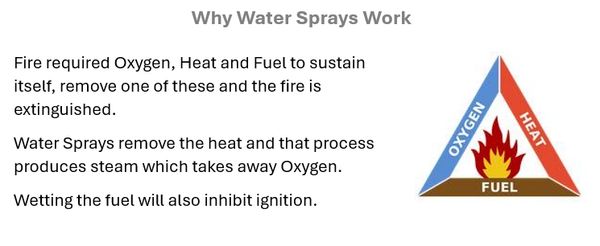
  •  Fire required Oxygen, Heat and Fuel to sustain itself, remove one of these and the fire is extinguished. 
  • A bushfire travels quickly because the wind pushes the heat and fire brands ahead of it, preheating any material for faster ignition. Applying water an area will significantly slow the advance of a fire front.
  • Airbourne water droplets will help extinguish fire brands, stopping spot fires igniting and significantly slowing the advance of a bushfire.
  • Wetting the foliage and ground cover will increase the vegetations fire resistance, making it harder to ignite.
  • Wetting a structures surfaces helps to extinguish hot embers before they can heat up and ignite. 

How it Works

  •  Water is supplied to the sprinklers by a pump fed by from a Static Water Source. The pump can be fuel or electric driven and may be remote start or manual start.
  • The sprays are strategically positioned around the perimeter of the structures and the landscape to target flying embers before they can reach combustible materials.
  • A well designed system can deliver a water efficient system that utilises your resources to provide a barrier of water between the fire front and your property. 
  • Large water droplets are effected less by high winds that accompany a Bushfire. The Rainmaker Drencher Heads are specifically designed for this. 

Which Type of Spray System

Your level of protection should be related to your Bushfire Attack Level Number, we have listed our minimum equipment recommendations in the About Spray Systems Folder.

We recommend having a multi layered spray system, 

  • Outer Zone which uses Soakers (Impacts) to wet a large area and increase the humidity of your property in a high fire danger period. 
  • Inner Zone which uses Drencher Heads or Nozzles to throw up a shield of water around your home as the fire front approaches.
  • Flame Zone which uses window and wall drenchers to throw water directly onto your homes surfaces when the front arrives.

All our spray heads have been designed with this strategy in mind.

your bushfire Attack Level

An External Water Spray (EWS) or Wind-Enabled Ember Dousing System (WEEDS) are bushfire protection systems that utilize specially designed bushfire sprinklers or high-pressure water spray nozzles to create a protective water barrier around a structure. This system effectively douses embers and wets surfaces, preventing ignition during high-wind wildfire events. 


Wind Resistance: The nozzles are directed outward and are engineered to operate under windy conditions, utilizing the wind to help disperse the water onto the surfaces of the house. 

Water Coverage: The spray coverage is intended to wet down the roof and other critical surfaces of the house, forming a shield against wind-driven embers and radiant heat. 

Embers: This fire sprinkler system for houses is specifically designed to combat ember ignition, with testing demonstrating that it produces a sufficient density of water to douse firebrands that can travel long distances in the wind. With house sprinkler systems like these, homeowners can enhance their protection against bushfire threats.

Table explaining BAL levels and associated fire risks from low to extreme.
Diagram illustrating ember attack levels on houses with corresponding fire protection methods.

Suggested Products

Portable Systems

Diagram of a building with fire protection zones and exposure areas marked.

Easy to Use

Easy to Maintain

Easy to Maintain

Setting up a Rainmaker Portable Sprinkler is very similar to a garden sprinkler. Decide where you want it to go, connect it to a water source, then turn it on.

Close-up of a brass impact sprinkler head with maintenance instructions.

Easy to Maintain

Easy to Maintain

Easy to Maintain

The ability to take your sprinklers down from the gutter allows for easier maintenance if things go wrong, and packing them away at the end of the fire season prompts regular maintenance. 

A green garden hose connected to a sprinkler on a house roof under a partly cloudy sky.

Cost effective

Easy to Maintain

Cost effective

Compared to a fixed system the Rainmakers are very cost effective. DIY install and the ability to add to the system in the future, makes for a robust, adaptable alternative to professional installation.

Fixed Systems

Copper pipes and a brass sprinkler head on a gray corrugated metal roof.

Need Some Help

Solid State

Fixed systems are generally more complicated than a portable systems as they need to be designed to defend the structure from your BAL  attack level.

Brass valve on a wet metal surface under a clear blue sky.

Solid State

Need Some Help

Solid State

Our spray nozzles have no moving parts and have been designed to use specified flow rates. Allowing for your system to be engineered for maximum efficiency.

A round blue button with the word 'HELP' in bold letters.

Need Some Help

Need Some Help

Need Some Help

Visit our Design Page for details on how we can help you defend your home.

Copyright © 2026 Rainmaker Bushfire Sprinklers - All Rights Reserved.

  • Terms & Conditions
  • Drencher Head Maintenance
  • Terms and Conditions

Powered by

Cookie Policy

This website uses cookies. By continuing to use this site, you accept our use of cookies.

Accept & Close